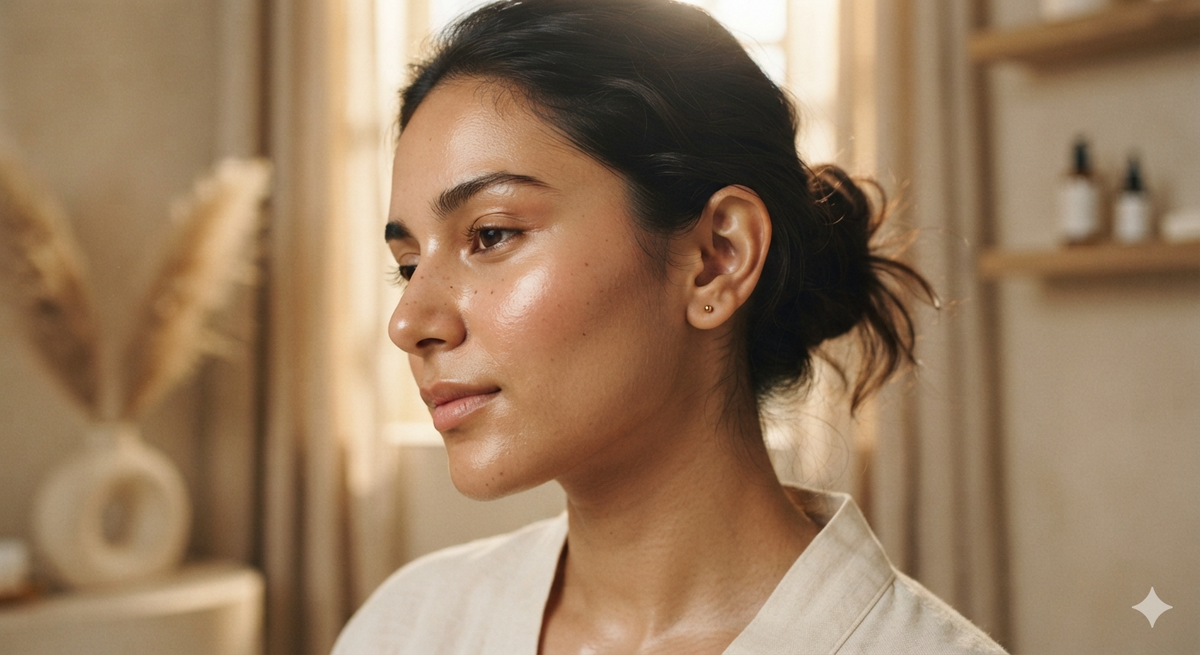
The skin barrier is the outermost layer of skin — the stratum corneum — made of dead skin cells held together by lipids like ceramides, cholesterol, and fatty acids. It keeps moisture in and irritants out. When it's damaged, skin becomes dry, red, sensitive, and prone to breakouts, all at once.

Fatima's Story
Fatima, 26, lives in Lahore. Two years ago her skin was calm. Now it's tight after every wash, flares red for no reason, and breaks out in patches she's never had before. She's tried six different moisturizers. Each one works for a week, then stops.
Fatima's dermatologist told her she has "sensitive skin." That's not wrong, but it's incomplete. Sensitive skin isn't something you're born with — for most Pakistani women, it's something that happens to you, one wash at a time.
What She's Been Doing Wrong
Fatima cleanses twice a day with a foaming face wash. She uses a toner with alcohol "to close her pores." She exfoliates twice a week because a beauty influencer said glowing skin needs it. Every one of these steps strips her barrier a little more. And every strip makes the next product sting more than it should.
The Mechanism Nobody Explained to Her
Here's what's actually happening. Lahore's tap water measures 300–600 ppm TDS (total dissolved solids) — roughly five times higher than the water most skincare is formulated and tested in. Every time Fatima washes her face, calcium and magnesium ions in that water bind to her skin's surface lipids and pull them away. Foaming cleansers at pH 6–8 compound the damage, since healthy skin sits at pH 4.5–5.5.

The result is a barrier with visible gaps in its lipid matrix — like grout missing between bathroom tiles. Water escapes faster than it should (this is called transepidermal water loss, or TEWL). Irritants get in faster than they should. Her skin responds the only way it knows how: inflammation, oil overproduction, and hypersensitivity to everything she puts on it.
What Actually Fixes It
The fix isn't a stronger product. It's rebuilding the lipid matrix directly, with the same materials skin already makes — ceramides — at a pH that doesn't fight against the repair.

- Step 1: Switch to a cleanser formulated at pH 5.0–5.5, using amino-acid surfactants that clean without stripping. (AMAZIA's Gentle Milky Amino Acid Cleanser is built specifically for this.)
- Step 2: Apply a ceramide-forward serum immediately after cleansing, while skin is still damp — Ceramide NP at 2.5% is a clinically meaningful, not cosmetic, concentration.
- Step 3: Seal with a barrier cream containing squalane and additional ceramides to lock the repair in.
What Happens If She Doesn't Fix It
Left alone, this cycle doesn't plateau — it compounds. Chronic barrier damage in Pakistani skin is linked to worsening post-inflammatory hyperpigmentation, since every fresh irritation re-triggers melanin production. Reactive skin can progress toward rosacea-type presentations that are harder and slower to reverse. And the "sensitive skin" label sticks, because the actual mechanism was never addressed.
Research on compromised skin barrier function has linked it to increased acne severity and inflammatory skin conditions, with ceramide deficiency commonly observed in affected skin compared to healthy controls.
Signs Your Skin Barrier Is Damaged
- Constant tightness within 30 minutes of washing
- Background redness that flares with almost any product, even "gentle" ones
- Dry patches despite moisturizing — the moisturizer sits on top instead of being retained
- Stinging or burning with previously well-tolerated products
- Simultaneous oiliness and dryness — oily T-zone, flaky cheeks
- Dull, uneven tone from disrupted cell turnover
Does Hard Water Cause Acne?
Hard water doesn't cause acne directly, but it triggers the mechanism behind it. Mineral deposits and alkaline pH from hard water strip barrier lipids, and the skin responds to that damage by overproducing sebum as a protective measure — which combines with dead cells to form the comedones that become acne.
What Damages the Barrier in Pakistan Specifically
| Cause | Why It Matters Here |
|---|---|
| Hard tap water (280–520 ppm TDS by city) | Strips barrier lipids with every wash — the single largest, least-addressed cause in Pakistan |
| Over-cleansing | Twice-daily foaming cleansers at pH 6–8 fight against skin's natural 4.5–5.5 |
| High UV index (8–10+ in Karachi, Lahore, Islamabad) | Degrades ceramides and oxidizes barrier lipids |
| Extreme heat + humidity swings | Macerates the barrier in summer, dries it in winter |
| Alkaline soaps and scrubs | pH 9–11 bar soaps strip the acid mantle in one wash |
See the full city-by-city breakdown on our Hard Water Data page.
How Ceramide NP Repairs the Barrier

Ceramide NP is a lipid that makes up roughly 25% of the skin's natural barrier structure. Topically applied at a pharmaceutical-grade concentration, it integrates directly into the gaps in the barrier's lipid matrix — rebuilding the physical structure rather than just moisturizing the surface. Consistent use is associated with measurable barrier restoration within about 7 days. Explore the full science on our Ingredients page.
Roman Urdu FAQ
Skin barrier kya hota hai?
Skin barrier aapki skin ki upar wali layer hai jo moisture ko andar rakhti hai aur irritants ko bahar. Jab yeh damage hoti hai, skin dry, red, aur sensitive ho jati hai.
Hard water se skin barrier kyun kharab hoti hai?
Pakistan ka tap water bohot "hard" hai — ismein calcium aur magnesium zyada hotay hain. Yeh minerals skin ki natural lipids ko wash ke dauran nikal detay hain, jiski wajah se barrier weak ho jati hai.
Barrier repair mein kitna time lagta hai?
Consistent routine ke saath, 7 din mein visible improvement shuru ho jati hai. Full repair 2–4 hafton mein hoti hai.
Kya ceramide sab skin types ke liye safe hai?
Haan. Ceramide skin ka natural component hai, isliye yeh oily, dry, aur sensitive — teeno skin types ke liye safe aur faidemand hai.
The AMAZIA Barrier Repair Routine
- Cleanse — Gentle Milky Amino Acid Cleanser, AM and PM, pH 5.0–5.5
- Repair — Barrier Support Serum with Ceramide NP 2.5%, applied to damp skin
- Seal — Deep Hydration Barrier Cream with squalane and additional ceramides

Shop the Barrier Repair Collection → · COD available nationwide · 7-Day Satisfaction Guarantee
Author: Abiha Eman Hashmi, Founder, AMAZIA Skincare. AMAZIA Skincare is Pakistan's skin barrier authority, formulated specifically for Pakistan's hard water and climate. GMP SSM-GMPNI-878 · ISO 9001:2015 AMER500187 · Halal HC-26/HMNL-528.
Comments
Comments are moderated — yours will appear after review.
Be the first to share your thoughts on this article.