Why Your Skin Feels Dry Even After Moisturizing
If your skin feels tight, dry, or slightly irritated after washing your face—even when you're using a “gentle” cleanser—the problem may not be your skincare.
It might be your water.
Across many cities in Pakistan, tap water is classified as hard water, meaning it contains high levels of dissolved minerals like calcium and magnesium.
Peer-reviewed research confirms that hard water exposure is associated with impaired skin barrier function and a higher risk of atopic eczema in children, based on a systematic review and meta-analysis of over 385,000 participants.
And most people never consider it.
💧 What Is Hard Water (And Why It Matters for Skin)?
Hard water is water that contains elevated mineral content, mainly:
- Calcium
- Magnesium
When this water touches your skin, two things happen:
1. Mineral residue forms on skin
These minerals don’t fully rinse off and can stay on the skin surface.
2. Soap becomes less effective
Hard water reacts with cleansers and forms “soap scum,” leaving behind a thin film on your skin.
This film can:
- Block moisturizer absorption
- Clog pores
- Trigger tight, dry feeling after washing
🧪 The Science: How Hard Water Damages Your Skin Barrier
Your skin has a protective outer layer called the skin barrier (or stratum corneum). Its job is to:
- Lock moisture in
- Keep irritants out
- Maintain healthy pH (~5.5)
Hard water disrupts this system in multiple ways:
🔬 1. Raises skin pH
Hard water is more alkaline than skin, which temporarily disrupts your acid mantle.
Healthy skin = pH 4.5–5.5
Hard water = can push skin higher
This weakens barrier function over time.
🧱 2. Breaks down ceramides
Ceramides are the “cement” that holds your skin cells together.
A clinical study published in the Journal of Investigative Dermatology found that washing with hard water significantly increases surfactant deposits on skin, raising transepidermal water loss and causing irritation — confirming that hard water measurably weakens the barrier's lipid structure, especially in combination with everyday cleansers.
💦 3. Increases water loss (TEWL)
When the barrier is weak, your skin loses moisture faster than it can retain it.
Result:
- Tightness after washing
- Flaky patches
- Persistent dryness
🧼 4. Leaves soap residue behind
Hard water reacts with soap and creates insoluble residue that sits on the skin.
This can:
- Irritate sensitive skin
- Trigger breakouts
- Make skin feel “unclean” even after washing
🇧🇰 Why This Is Worse in Pakistan
In many regions of Pakistan (especially urban areas), water hardness levels are significantly above recommended comfort ranges.
Combined with:
- High heat (30–45°C summers)
- Pollution exposure
- Frequent face washing
- Strong cleansers used for “oil control”
This creates a constant barrier stress cycle.
Over time, skin becomes:
- More sensitive
- More dehydrated
- More reactive to products
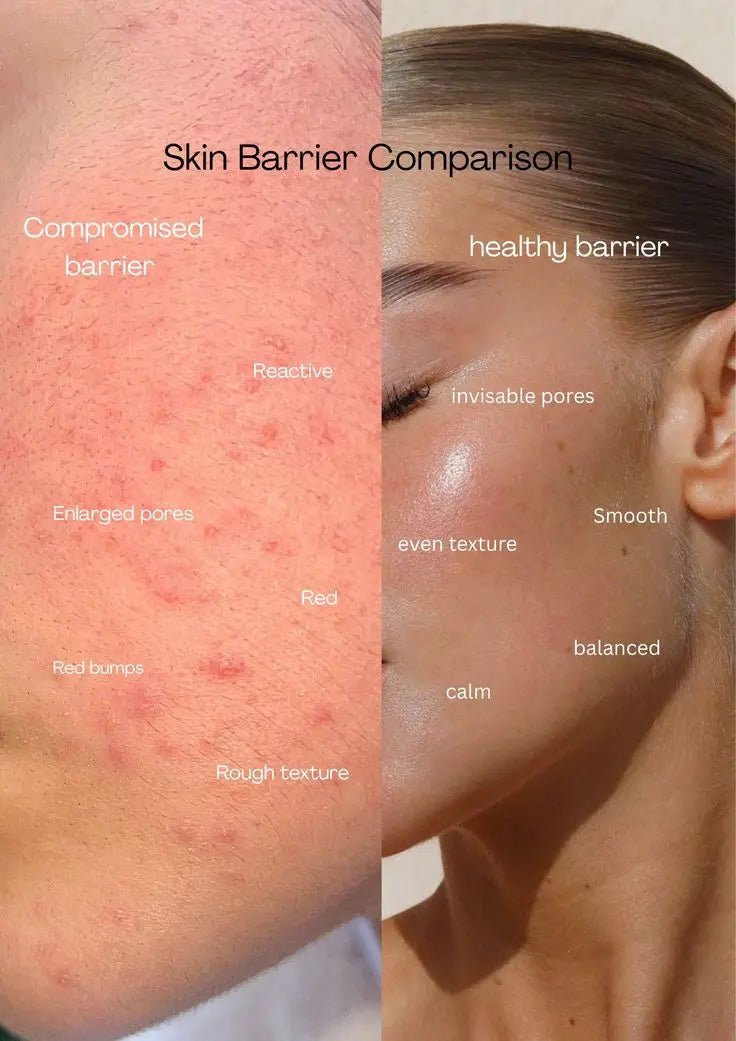
⚠️ Signs Your Skin Barrier Is Being Affected
You might already be experiencing this if:
- Skin feels tight 20–30 minutes after washing
- Moisturizer doesn’t seem to “work”
- Products suddenly sting
- Redness or irritation appears easily
- Dry patches appear around nose, cheeks, jawline
- Breakouts show up in unusual areas
These are classic signs of a weakened skin barrier.
🧴 The Ingredients That Actually Help (Science-Based)
Not all skincare can fix this. You need barrier-repair focused actives.
1. Ceramides (especially Ceramide NP)
Ceramides restore the “cement” between skin cells and rebuild barrier structure.
They help:
- Reduce moisture loss
- Strengthen skin defense
- Improve long-term resilience
2. Ectoin (0.5% clinically studied range)
Ectoin is a stress-protection molecule originally found in extremophile microorganisms.
It helps:
- Protect against environmental stress
- Reduce irritation
- Lock in hydration
- Strengthen barrier stability
It is now widely recognized as a premium barrier-support ingredient.
3. Niacinamide (Vitamin B3)
Niacinamide supports:
- Sebum balance
- Pore refinement
- Barrier repair
- Reduced inflammation
4. pH-balanced skincare (around 5.5)
This helps restore skin’s natural acid mantle disrupted by hard water.
🧴 The SIMPLE Routine That Actually Works
If your skin barrier is damaged, don’t overload it.
Keep it minimal:
Morning:
- Gentle pH-balanced cleanser
- Barrier repair serum (ceramides + ectoin)
- Lightweight moisturizer
- Sunscreen
Night:
- Gentle cleanser
- Barrier serum
- Moisturizer
That’s it.
No over-exfoliation. No harsh actives.
⏳ How Long Does It Take to Repair Skin Barrier?
Most dermatology studies suggest improvement in:
- 2–4 weeks for mild damage
- 4–8 weeks for moderate damage
Consistency matters more than product quantity.
🧠 Important Truth Most People Miss
It’s not always:
- “Your cleanser is too strong”
- “Your skin is sensitive”
- “You need more skincare”
Sometimes the real issue is:
The environment your skin is living in every single day.
And in Pakistan, hard water is one of the most overlooked skin stressors.
🌿 How AMAZIA Skincare Fits In
AMAZIA Skincare is formulated specifically for:
- Pakistan’s hard water conditions
- High heat + humidity climate
- Barrier-sensitive skin
With:
- 0.5% Ectoin
- Ceramide NP
- pH-balanced formulas (~5.5)
Designed to help skin recover from daily environmental stress.
👉 Explore the Barrier Support Serum, formulated around exactly the mechanisms explained above.
If breakouts are part of your barrier story too, see our guide to acne treatment in Pakistan. And if uneven tone or brightness is the goal, read skin whitening vs. skin glow for the barrier-first approach to real glow.
❓ FAQ
Does hard water really damage skin?
Yes. Peer-reviewed research links hard water exposure to weakened skin barrier function, increased dryness, and higher irritation risk, particularly in sensitive skin types.
Can hard water cause acne?
It may contribute indirectly by leaving residue on skin and disrupting cleansing effectiveness.
How do I protect my skin from hard water?
Use a gentle cleanser, barrier-repair serum (ceramides + ectoin), and moisturizer to strengthen the skin barrier.
Is hard water common in Pakistan?
Yes, many regions in Pakistan have hard to very hard water due to high mineral content.
📌 Final Takeaway
If your skin constantly feels dry, tight, or irritated despite using skincare—
it’s not always about adding more products.
Sometimes it’s about fixing what your skin is exposed to every day.
And for many people in Pakistan, that starts with understanding hard water + skin barrier damage.
Written by Abiha Eman Hashmi, Founder, AMAZIA Skincare.
Sources: Jabbar-Lopez ZK, et al. “The effect of water hardness on atopic eczema, skin barrier function: A systematic review, meta-analysis.” Clinical & Experimental Allergy, 2021 — PubMed; Danby SG, et al. “The Effect of Water Hardness on Surfactant Deposition after Washing and Subsequent Skin Irritation.” Journal of Investigative Dermatology, 2018 — PubMed.
Comments
Comments are moderated — yours will appear after review.
Be the first to share your thoughts on this article.